
Summary
- Non-surgical skin tightening treatments can help improve mild to moderate skin laxity, firmness, fine lines and facial contours by stimulating collagen production and remodelling within the skin and deeper tissues.
- Treatment options at Stephanie Ho Dermatology include focused ultrasound (HIFU), synchronous ultrasound, radiofrequency (RF) microneedling and collagen-stimulating injectables. Each works differently and targets different layers of the skin and underlying tissues.
- The most appropriate treatment depends on the degree and location of skin laxity, skin quality, facial structure, treatment goals and tolerance for downtime. Treatments may also be combined to address different aspects of skin ageing.
- Results generally develop gradually over the following weeks to months as new collagen is produced and existing collagen remodels. The degree and duration of improvement vary between individuals and treatment types.
- Most non-surgical treatments involve relatively little downtime, although temporary redness, swelling, tenderness or bruising may occur depending on the procedure. A dermatologist can assess your skin and facial anatomy and recommend an appropriate treatment plan.
Non-Surgical Lifting and Firming for the Face, Eyes and Neck
As we age, collagen and elastin production gradually decline. Changes also occur in facial fat, supporting ligaments and deeper tissues, contributing to looser skin, fine lines, jowling and reduced definition of the face and neck.
Non-surgical skin tightening treatments use different technologies or injectable treatments to stimulate collagen production and improve the support and quality of the skin. Depending on the treatment selected, they may help to:
- Improve mild to moderate skin laxity
- Improve skin firmness and elasticity
- Soften fine lines and wrinkles
- Improve definition along the jawline and lower face
- Improve laxity around the eyes and neck
- Improve overall skin texture and quality
At Stephanie Ho Dermatology, we offer several approaches to non-surgical skin tightening, including focused ultrasound (HIFU), synchronous ultrasound, RF microneedling and collagen-stimulating injectable treatments.
Different treatments work at different depths and are suited to different concerns. Ultrasound treatments can target deeper or mid-dermal tissue depending on the technology used, while RF microneedling primarily targets the dermis to stimulate collagen remodelling and improve skin quality. Collagen-stimulating injectables can provide additional support by encouraging gradual collagen production within the skin.
Treatment is therefore selected according to your facial anatomy, degree of skin laxity, skin quality and desired outcome, rather than using the same procedure for everyone. In some patients, a combination approach may be appropriate to address both deeper laxity and more superficial changes in skin texture and firmness.
Types of Skin Tightening Treatments
Different skin tightening technologies work at different depths and stimulate collagen in different ways. There is no single treatment that is best for everyone. The most appropriate option depends on the degree of skin laxity, treatment area, skin quality, facial anatomy and the results you are hoping to achieve.
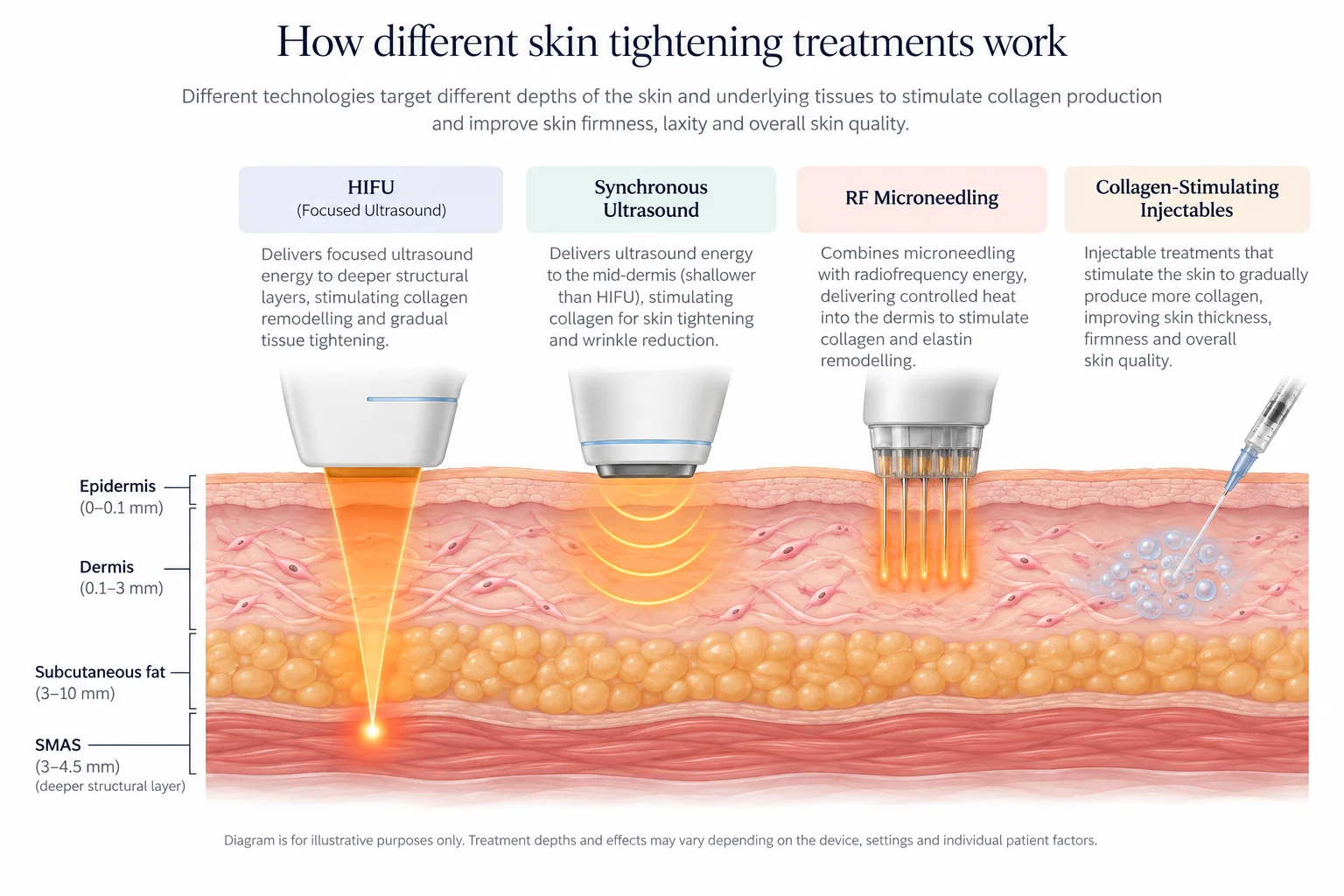
Different skin tightening treatments target different layers of the skin and underlying tissues. HIFU targets deeper supporting layers for lifting and contouring, while synchronous ultrasound and RF microneedling stimulate collagen within the skin at different depths. Collagen-stimulating injectables work differently, encouraging gradual collagen production to improve dermal support and skin quality. Treatment depths vary according to the technology, settings and individual patient.
High-Intensity Focused Ultrasound (HIFU)
High-Intensity Focused Ultrasound (HIFU) delivers focused ultrasound energy to deeper tissue planes beneath the skin, creating controlled thermal stimulation that triggers collagen remodelling and gradual tissue tightening.
Compared with treatments that work primarily within the skin, HIFU can target deeper tissue planes. This makes it particularly useful when the aim is to achieve a more noticeable improvement in lifting, tightening and facial contour.
It can help to:
- Lift and tighten mildly to moderately lax skin
- Improve definition of the jawline and lower face
- Reduce the appearance of early jowling
- Improve laxity beneath the chin
- Create a more defined facial contour
- Provide visible, natural-looking lifting without surgery
Best suited for: Patients with mild to moderate facial or neck laxity who are looking for visible lifting, tightening and contouring without surgery.
HIFU needs to be selected carefully according to facial anatomy. In patients with a naturally small, thin or lean face with little facial volume, deeper treatment may produce more facial definition or contouring than desired. In these patients, a treatment that focuses more superficially on skin firmness and collagen stimulation while preserving existing facial fullness may be preferable.
Treatment frequency: Often performed approximately once a year, although this varies according to the individual and treatment protocol.
Some tightening may be noticeable earlier, but results generally continue to develop over the following weeks to months as collagen remodels. Many appropriately selected patients see a visible improvement in facial definition, lifting and skin tightness, although the degree of improvement varies according to age, anatomy, baseline laxity and individual response.
HIFU can be uncomfortable for some patients, so appropriate pain-control measures are used to make the procedure as comfortable as possible.
Synchronous Ultrasound
Synchronous ultrasound delivers ultrasound energy within the mid-dermis, at a shallower level than deeper focused-ultrasound treatments. Its primary aim is to stimulate collagen production and improve the firmness and quality of the skin.
It can help to:
- Improve mild to moderate skin laxity
- Improve skin firmness and elasticity
- Soften fine lines and wrinkles
- Improve early signs of skin ageing
- Tighten the skin while preserving existing facial fullness and contour
Best suited for: Patients looking for gradual skin tightening and improvement in fine lines with minimal downtime and generally greater treatment comfort.
Synchronous ultrasound can be particularly useful for patients with a small, thin or lean face who already have good facial definition and do not require additional contouring. Because treatment is focused more superficially within the skin, its primary purpose is to improve skin firmness and collagen production rather than alter facial volume or shape.
This makes it an attractive option for patients who want their skin to look firmer, smoother and tighter while maintaining the natural fullness and proportions of their face.
Treatment frequency: Typically once or twice a year, depending on the degree of laxity and individual response.
The lifting effect is generally more subtle than treatments targeting deeper tissue planes. Synchronous ultrasound can therefore be particularly useful when the goal is skin tightening rather than deeper facial contouring, when preserving facial fullness is a priority, or when patients prefer greater treatment comfort and minimal downtime.
Radiofrequency (RF) Microneedling
RF microneedling combines microneedling with controlled radiofrequency energy delivered into the dermis. This creates targeted thermal stimulation that promotes collagen and elastin remodelling.
Unlike deeper lifting treatments, RF microneedling is particularly useful when skin texture and skin quality are important concerns alongside mild laxity.
It can help to improve:
- Fine lines
- Enlarged pores
- Uneven skin texture
- Acne scars
- Mild to moderate skin laxity
- Crepey skin and loss of firmness
RF microneedling can also be used carefully on areas such as the lower face, neck and décolletage, depending on the patient’s skin, anatomy and treatment goals.
Best suited for: Patients who want to improve skin texture and firmness at the same time, particularly when enlarged pores, fine lines or acne scarring are also present.
Treatment frequency: Usually performed as a course of treatments, with the number and interval determined according to the skin concern and treatment response.
Temporary redness, swelling or pinpoint marks may occur after treatment. Downtime is generally short, although this varies with treatment intensity and individual skin response.
Collagen-Stimulating Injectables (Biostimulators)
Collagen-stimulating injectables work differently from energy-based devices. Rather than using heat or ultrasound, these injectable treatments stimulate the skin to gradually produce more of its own collagen.
Depending on the product and treatment technique, they can help to:
- Improve skin thickness and firmness
- Improve elasticity
- Improve overall skin quality
- Provide gradual dermal and structural support
- Soften some of the visible changes associated with skin ageing
Best suited for: Patients with early to moderate changes in skin firmness, elasticity or dermal support who prefer a gradual, natural-looking improvement.
The effect depends on the product used, injection depth and treatment technique. Some collagen stimulators are used primarily to improve skin quality and firmness, while others can also provide greater structural support or restore some facial volume.
Results develop progressively over several weeks to months as new collagen is produced. Collagen-stimulating injectables can be particularly useful as part of a combination treatment plan because they address dermal quality and support, while ultrasound and RF treatments stimulate collagen through different mechanisms and at different tissue depths.
Comparing Skin Tightening Treatments
| Treatment | Primary role | Particularly useful for | Typical treatment frequency |
|---|---|---|---|
| High-Intensity Focused Ultrasound (HIFU) | Deeper lifting, tightening and contouring | Jawline definition, early jowling, lower-face and neck laxity | Often approximately once yearly |
| Synchronous ultrasound | Skin tightening and collagen stimulation while preserving facial fullness | Mild laxity, fine lines, thin or lean faces and patients prioritising comfort | Typically once or twice yearly |
| RF microneedling | Dermal remodelling and improvement in skin quality | Fine lines, enlarged pores, acne scars, texture and mild to moderate laxity | Usually performed as a course |
| Collagen-stimulating injectables | Gradual collagen stimulation, dermal support and improvement in skin quality | Reduced firmness, elasticity and dermal support | Individualised according to the product and treatment plan |
Combining Treatments for More Comprehensive Results
Skin ageing occurs at multiple levels of the face, rather than in the skin alone. There may be laxity of deeper supporting tissues, loss of collagen within the dermis, changes in facial volume and, at the surface, fine lines, enlarged pores, pigmentation or uneven texture.
This is why combining treatments that work at different tissue depths and through different mechanisms can sometimes produce a more comprehensive result than relying on a single treatment.
For example:
- HIFU + collagen-stimulating injectables: HIFU can provide deeper lifting, tightening and improved facial contour, while collagen-stimulating injectables work more gradually to improve dermal thickness, firmness, elasticity and support. This combination can be useful when the aim is to achieve both visible lifting and an improvement in overall skin quality.
- Synchronous ultrasound + collagen-stimulating injectables: Synchronous ultrasound can improve skin firmness and mild laxity while maintaining existing facial fullness, while biostimulators provide additional gradual collagen production and dermal support. This can be particularly useful for thin or lean faces where preserving facial fullness is important, or for patients looking for subtle, progressive rejuvenation with minimal downtime.
- RF microneedling + collagen-stimulating injectables: RF microneedling promotes dermal collagen remodelling and is particularly useful for pores, fine lines, acne scars, texture and mild laxity. Adding a collagen-stimulating injectable can provide additional improvement in skin thickness, elasticity and dermal support.
- Ultrasound + RF microneedling: These treatments can complement one another because they address different aspects of ageing. Ultrasound can be selected for lifting and tightening, while RF microneedling focuses more on skin texture, firmness and dermal remodelling.
Where appropriate, laser or light-based treatments can also be incorporated to address pigmentation, redness or uneven skin tone, while other injectable treatments may be used when facial volume or structural support also needs to be addressed.
The aim of combination treatment is not simply to perform more procedures. It is to identify the different components contributing to facial ageing and select treatments that complement one another.
For example, a patient with early jowling and reduced jawline definition together with crepey or sun-damaged skin may benefit more from a deeper ultrasound treatment for lifting combined with RF microneedling or a collagen-stimulating injectable to improve skin quality, rather than repeatedly treating only one layer.
Conversely, a patient with a naturally thin face and good facial contours but increasing skin laxity and fine lines may be better suited to synchronous ultrasound, RF microneedling or collagen-stimulating treatments that focus on improving skin quality and firmness while maintaining existing facial fullness.
Treatments do not necessarily need to be performed during the same session. They can be carefully selected and staged according to facial anatomy, skin condition, treatment goals and desired downtime.
A dermatologist assessment can help determine whether the main concern is deeper laxity, loss of dermal support, deterioration in skin quality — or a combination of these — and develop an individualised treatment plan accordingly.
What Results Can You Expect?
Results from non-surgical skin tightening treatments are generally gradual and natural-looking. Most treatments work by stimulating new collagen production and remodelling existing collagen, so improvement continues to develop over the following weeks to months.
Depending on the treatment selected, you may notice:
- Gradual lifting and tightening
- Improved skin firmness and elasticity
- Better definition of the jawline and lower face
- Softening of fine lines
- Improved skin texture and quality
- A fresher, more rejuvenated appearance
Different treatments produce different types of improvement. HIFU is used when greater lifting, tightening and facial contouring are desired, while synchronous ultrasound focuses more on improving skin firmness and fine lines while maintaining existing facial fullness. RF microneedling is particularly useful when skin texture, pores or acne scars are concerns alongside laxity, while collagen-stimulating injectables gradually improve dermal support and skin quality.
The best results are generally seen in patients with mild to moderate skin laxity. Non-surgical treatments cannot reproduce the degree of lifting achieved with surgery, and patients with more advanced skin sagging may be better suited to surgical options.
Comfort During Treatment
Comfort varies according to the treatment and the area being treated.
Topical numbing cream is used where appropriate, and additional pain-control measures may be offered when needed. Synchronous ultrasound is generally well tolerated, while RF microneedling is usually performed after topical anaesthesia. HIFU can be more uncomfortable because treatment reaches deeper tissue planes, and additional measures may be used to improve comfort.
Your dermatologist will discuss what to expect before treatment.
Pre-Treatment Consultation
A consultation is important because the most appropriate treatment depends not only on how loose the skin appears, but also on facial anatomy, facial volume, skin quality and the depth at which treatment is required.
During your consultation, your dermatologist will:
- Assess the degree and distribution of skin laxity
- Evaluate your facial anatomy and skin quality
- Identify whether the main concern is deeper laxity, loss of firmness, changes in skin texture or a combination of these
- Recommend the most appropriate treatment or combination of treatments
- Discuss the expected degree and timing of improvement
- Explain the recommended number and frequency of treatments
- Discuss potential side effects, downtime and aftercare
This individual assessment is particularly important when selecting treatments for areas such as the lower face and neck, where facial structure and existing volume can influence treatment choice.
Aftercare and Recovery
Recovery varies according to the procedure, but most non-surgical skin tightening treatments involve relatively little downtime.
Depending on the treatment, temporary effects may include:
- Mild redness
- Swelling
- Tenderness or sensitivity
- Bruising following injectable treatments
Most patients can return to normal daily activities the following day, although recovery varies according to the treatment intensity and individual response.
You will receive specific aftercare advice regarding skincare, sun protection and what to expect during recovery. Because collagen production and remodelling take time, results should be assessed over the following weeks to months rather than immediately after treatment.
Why Specialist Care Matters
Skin tightening is not simply a matter of choosing a device. Different treatments reach different tissue depths and have different effects on the skin and underlying tissues.
Safe and effective treatment requires:
- Selecting the appropriate treatment for the patient’s concerns and facial anatomy
- Choosing suitable treatment depths and energy settings
- Understanding facial anatomy and areas requiring particular caution
- Recognising when preserving facial fullness is important
- Identifying when a combination of treatments may be more appropriate
- Setting realistic expectations about what non-surgical treatment can achieve
At Stephanie Ho Dermatology, treatment is individualised according to your facial anatomy, skin quality, degree of laxity and treatment goals.
Where appropriate, different treatments may be combined or staged to address different components of facial ageing. The aim is to achieve natural-looking improvement in lifting, firmness, facial definition and overall skin quality, while maintaining an emphasis on appropriate patient selection and safety.
Frequently Asked Questions
How often do I need skin tightening treatment?
The frequency of treatment depends on the technology used, your degree of skin laxity and how your skin responds.
HIFU is often performed approximately once a year, while synchronous ultrasound may be performed once or twice yearly. RF microneedling is usually performed as a course of treatments, particularly when concerns such as fine lines, enlarged pores, acne scars or skin texture are being treated at the same time. Collagen-stimulating injectables have different treatment schedules depending on the product used and the treatment goal.
Maintenance treatments may be recommended as the skin continues to age. Your dermatologist will advise you on an appropriate treatment interval rather than following the same schedule for every patient.
How soon will I see results from skin tightening?
Most non-surgical skin tightening treatments produce gradual rather than immediate results because they work by stimulating collagen production and remodelling.
Some patients may notice early improvement in firmness or tightening, but results generally continue to develop over the following weeks to months.
The timing and degree of improvement depend on the treatment performed, your age, skin quality, degree of laxity and individual collagen response. Patients with mild to moderate skin laxity are generally the best candidates for non-surgical treatments. More advanced skin sagging may require surgical treatment to achieve a significant lifting effect.
How long do skin tightening results last?
Skin tightening treatments cannot stop the natural ageing process, so results are not permanent. However, the collagen produced and remodelled following treatment can provide improvement that persists beyond the initial treatment period.
How long the results last varies according to the treatment, your age, skin condition, lifestyle and the natural rate at which your skin continues to age. Periodic maintenance treatment may help maintain the improvement over time.
Is there downtime after skin tightening treatment?
Downtime depends on the treatment performed.
HIFU and synchronous ultrasound generally involve little to no visible downtime, although temporary tenderness, sensitivity or mild swelling can occasionally occur.
After RF microneedling, the skin is usually mildly pink or red on the day of treatment but typically returns to normal by the following day. Rarely, small needle marks may remain visible for slightly longer.
Collagen-stimulating injectables may cause temporary swelling or tenderness at the injection sites. Bruising can occur but is uncommon.
Your dermatologist will explain the expected recovery period for your particular treatment before the procedure.
Is skin tightening treatment painful?
Comfort varies considerably between treatments and between individuals.
Synchronous ultrasound is generally well tolerated. RF microneedling is usually performed after topical anaesthetic cream to improve comfort.
HIFU can be more uncomfortable because focused ultrasound energy is delivered to deeper tissue planes. At Stephanie Ho Dermatology, we have developed a range of pain-control strategies to improve comfort during treatment. The approach can be tailored according to the treatment area and individual sensitivity.
Your dermatologist will discuss what the treatment is likely to feel like and the appropriate pain-control options before your procedure.
Which skin tightening treatment is right for me?
There is no single skin tightening treatment that is best for everyone. The most appropriate treatment depends on your facial anatomy, existing facial volume, degree and location of skin laxity, skin quality and treatment goals.
For example, HIFU may be appropriate when greater lifting and facial contouring are desired. Synchronous ultrasound may be preferred when the aim is to improve skin firmness and fine lines while maintaining existing facial fullness, particularly in patients with naturally thin or lean faces.
RF microneedling may be particularly useful when skin texture, pores, acne scars or fine lines are concerns alongside mild laxity. Collagen-stimulating injectables can be considered when improving dermal support, firmness and overall skin quality is a priority.
Some patients may benefit from combining or staging treatments that work at different depths, while others may need only one treatment. A dermatologist assessment helps determine which approach is most appropriate.
Will skin tightening treatments make my face look thinner?
Not necessarily. This depends on the treatment selected, treatment depth and your existing facial anatomy.
Some patients want greater definition of the lower face and jawline, while others — particularly those with a naturally small or lean face — may want firmer skin without additional facial contouring.
Treatment can therefore be selected according to the desired result. Synchronous ultrasound works more superficially within the skin and can be useful when the aim is to improve firmness while maintaining existing facial fullness. Careful assessment of facial anatomy and volume is particularly important before deeper ultrasound treatments.
Can skin tightening improve fine lines and wrinkles?
Yes, although the most appropriate treatment depends on the type and location of the lines.
Treatments that stimulate collagen within the skin, such as synchronous ultrasound and RF microneedling, can help improve fine lines as well as skin firmness. RF microneedling can be particularly useful when fine lines occur together with enlarged pores or uneven skin texture.
HIFU primarily targets deeper tissue planes and is generally selected more for lifting, tightening and contouring than for treating superficial fine lines alone.
For some patients, combining skin tightening with other treatments may provide a more comprehensive improvement when wrinkles, pigmentation, redness or changes in facial volume are also present.
Can skin tightening improve jowls and the jawline?
Non-surgical skin tightening can improve the appearance of early jowling and reduced jawline definition, particularly when these changes are caused partly by mild to moderate tissue laxity.
HIFU is often considered when deeper lifting, tightening and improved lower-face definition are desired. However, jowling can also be influenced by facial volume changes, fat distribution, bone structure and more advanced tissue descent. These factors need to be assessed before deciding on treatment.
More significant jowling or skin sagging is unlikely to be fully corrected with non-surgical treatment and may require a surgical approach for a more substantial result.
Can skin tightening be used on the neck?
Yes. Depending on the treatment and individual anatomy, skin tightening procedures can be used to improve mild to moderate laxity, fine lines and crepey skin on the neck.
Different technologies may be selected depending on whether the main concern is deeper laxity, loss of skin firmness or changes in skin texture. The neck has different anatomy from the face, so treatment depth and settings need to be selected appropriately.
Who may benefit from skin tightening treatments?
Skin tightening treatments may be suitable for adults who are beginning to notice:
- Mild to moderate facial or neck laxity
- Early jowling or reduced jawline definition
- Loss of skin firmness or elasticity
- Fine lines
- Crepey skin
- Changes in skin texture and quality
They are particularly useful for patients seeking gradual, natural-looking improvement without surgery.
However, non-surgical treatments have limitations. Patients with significant skin laxity or more advanced facial ageing may achieve a greater degree of correction with surgery.
Can skin tighten naturally?
Skin has some capacity for repair and collagen production, but this gradually decreases with age. Collagen and elastin levels decline, while changes also occur in facial fat, ligaments and other supporting structures.
Healthy lifestyle habits, appropriate skincare and sun protection can help maintain skin quality, but they cannot usually reverse established facial or neck laxity.
Skin tightening treatments aim to stimulate new collagen production and remodelling to improve firmness and reduce the appearance of mild to moderate laxity. More significant sagging generally cannot be fully corrected without surgery.
Can I combine skin tightening with other aesthetic treatments?
Yes. In appropriately selected patients, combining treatments can address different layers and different aspects of facial ageing, allowing treatment to be tailored more precisely to the individual’s concerns.
For example, ultrasound treatments may be used for lifting and tightening, while RF microneedling can improve skin texture, pores, fine lines and firmness. Collagen-stimulating injectables can provide additional dermal support and improve skin quality.
Skin tightening can also be combined with other injectable treatments depending on the concerns being addressed. These may include neuromodulator injections for expression lines, injectable skin-hydrating or bioremodelling treatments for skin quality and hydration, and polynucleotide or other regenerative injectable treatments to improve skin quality and support.
Laser or light-based treatments may also be incorporated when pigmentation, redness, sun damage or uneven skin tone are concerns.
The aim is not simply to perform multiple treatments, but to select treatments that work in complementary ways. They do not necessarily need to be performed during the same session and may be staged as part of an individualised treatment plan.
Your dermatologist can recommend an appropriate combination and treatment sequence based on your facial anatomy, skin condition and treatment goals.
Book a Consultation
If you are concerned about skin laxity, early jowling, reduced facial definition or loss of skin firmness, a personalised consultation can help determine which treatment is most appropriate for you.
At Stephanie Ho Dermatology, treatment is selected according to your facial anatomy, skin quality, degree of laxity and individual treatment goals. Depending on your needs, this may involve a single treatment or a carefully planned combination of treatments targeting different aspects of skin ageing.
The aim is to achieve natural-looking improvement in skin firmness, lifting and overall skin quality while preserving your individual facial features.
Contact Stephanie Ho Dermatology to arrange a consultation and discuss your treatment options.